
Technical Overview: Working Principle of DPP Series Blister Machines
03/17/2017
The DPP series blister packaging machine operates on a highly synchronized, intermittent web transport system. The base forming material and the lidding foil are precisely advanced through each workstation by a servo-driven indexing traction mechanism (12).
1. Forming & Feeding: The base film (typically PVC, 1) is guided via the forming tension roller (2) into the heating plates (3). Once plasticized at the correct temperature, it enters the forming station (4), where positive compressed air (5) molds the film into cavities. As the web indexes forward, the product is accurately loaded into these cavities at the feeding station (6).
2. Sealing & Coding: The lidding foil (typically Aluminum, 8), routed through its tension roller (7), meets the formed PVC web at the heat-sealing station (9). The materials are thermally bonded to hermetically seal the product. The continuous web then passes through the embossing station (10) for batch number coding, followed by the perforation station (11), which scores tear lines between individual blisters.
3. Punching & Waste Collection: Finally, the sealed web enters the cutter station (13), where individual blister cards are cleanly punched out. The remaining skeletal waste material is routed over a tension stick (14) and collected by the automatic waste winding mechanism (15).
DPP Series Schematic Diagram
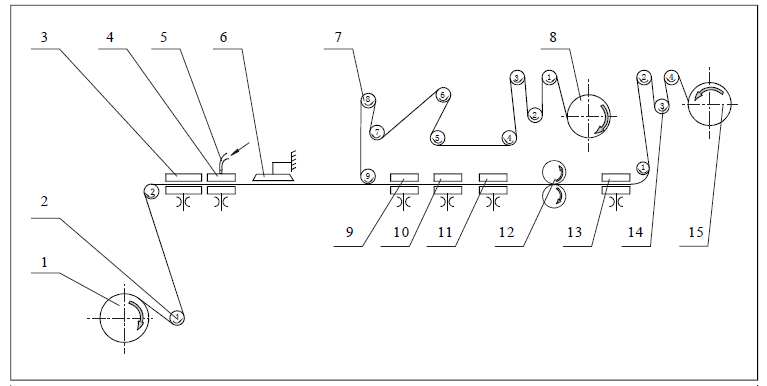
Machine Components Legend:
1. Forming Material (PVC)
2. Forming Tension Roller
3. Heating Plates
4. Cavity Forming Station
5. Compressed Air Supply
6. Product Feeding Device
7. Alu Foil Tension Roller
8. Lidding Foil (Alu)
9. Heat-Sealing Station
10. Embossing / Coding Station
11. Perforation Station
12. Indexing Traction Mechanism
13. Punching / Cutter Station
14. Waste Web Tension Roller
15. Waste Winding Mechanism