Technical Overview: Mechanical Drive Principle of DPP Series Blister Machines
03/20/2017
The drive architecture of the DPP series blister packaging machine relies on a robust mechanical cam system synchronized with precise servo-driven web indexing.
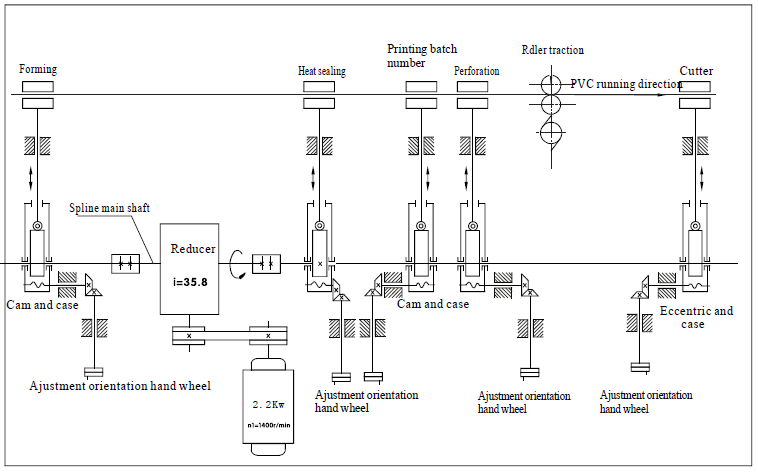
1. Main Shaft Transmission: The main motor drives the primary gear reducer, which in turn rotates the central splined shaft. The forming cam, heat-sealing cam, batch number embossing cam, perforation cam, and the cutter eccentric wheel are individually mounted along this main splined shaft.
2. Workstation Actuation & Alignment: As the splined shaft rotates, these cams (and the cutter’s eccentric wheel) translate rotational movement into precise vertical (up and down) strokes for each workstation, executing the forming, sealing, embossing, perforating, and cutting processes. With the exception of the stationary heat-sealing unit, all other workstations can be adjusted horizontally (left or right) via integrated handwheels. This ensures perfect registration and alignment between the molds and the formed blister cavities across different formats.
3. Servo-Driven Web Indexing: The intermittent web traction (pulling) mechanism is independently powered by a high-precision servo motor, ensuring accurate material advancement without stretching.
4. Operational Synchronization (The Kinematic Cycle):
The entire system operates on a strictly synchronized intermittent cycle:
The entire system operates on a strictly synchronized intermittent cycle:
-
- Tooling Phase: As the cams rise, the molds at each workstation close to perform their specific actions. During this phase, the servo-driven traction mechanism remains entirely stationary.
-
- Indexing Phase: As the cams decline and the molds open, the tooling phase concludes. The servo traction mechanism then engages, advancing the packaging web by one exact index length before the next tooling cycle begins.
DPP Series Mechanical Driving System Schematic