
Industry Insight: Evolutionary Trends in Blister Packaging Technology
03/30/2017
As a cornerstone of pharmaceutical production, blister packaging machinery is undergoing a rapid evolution. Modern packaging automation is no longer a localized concept; it demands the seamless integration of packaging machinery into broader production networks. To understand the current trajectory of blister packaging, it is essential to look at the four generational stages of automated packaging equipment:
-
- 1st Generation (Mechanical Automation): Relied on single main motors, gearboxes, and chain drives for power transmission.
-
- 2nd Generation (Hybrid Automation): Combined basic mechanical systems with key-axis servo control.
-
- 3rd Generation (Electronic Servo Control): Featured precision synchronized multi-axis motion, offering variable-speed operation and high format flexibility.
-
- 4th Generation (Smart Integration – Current Trend): Built on standardized software architectures, enabling full integration with MES (Manufacturing Execution Systems) and ERP platforms. Features distributed intelligence, decentralized diagnostics, and the seamless merging of primary and secondary packaging processes.
Aligned with global engineering standards, the development of modern blister packaging machinery is strictly focused on four core pillars: Automation, High-Speed Agility, Diversification, and Intelligence.
1. Automation: Intelligent Servo Indexing & Line Integration
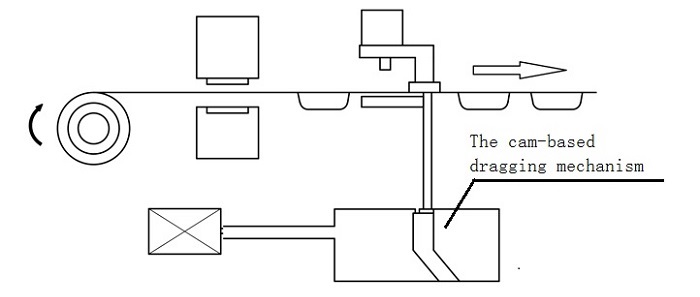
To achieve high speed and precision, intelligent servo control has replaced traditional mechanical linkages. Legacy systems (such as the old-generation JORNEN DPP250D shown in Figure 1) utilized cam-based mechanical indexing mechanisms. These required manual adjustment of the feeding length, limiting production efficiency and extending changeover times.
Figure 1: Legacy cam-based mechanical indexing mechanism (DPP250D series).
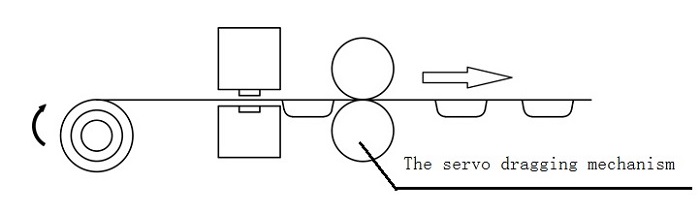
In contrast, modern architectures (like the JORNEN DPP260 series in Figure 2) employ independent servo-driven web traction. This eliminates mechanical backlash, ensuring accurate positioning, rapid continuous running, and digital adjustment of index lengths directly from the HMI.
Figure 2: Advanced servo-driven indexing mechanism (DPP260 series).
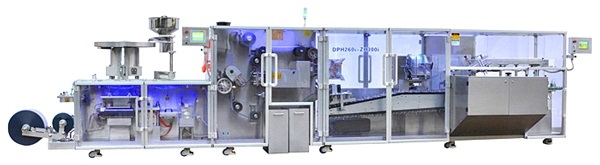
Automation also dictates line integration. Figure 3 highlights JORNEN’s high-efficiency integrated Blister and Cartoning lines, designed to maximize throughput while minimizing the physical footprint and operator intervention.
Figure 3: JORNEN Integrated Blister and Cartoning Packaging Lines.
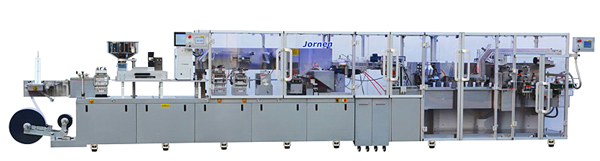
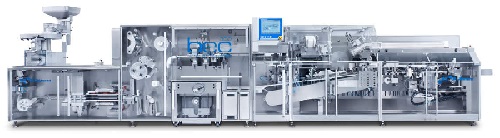
This trend is reflected globally. Figure 4 shows the Uhlmann Blister Express Center (BEC) 300, a fully servo-driven integrated line equipped with comprehensive Track & Trace modules to secure the pharmaceutical supply chain against counterfeiting.
Figure 4: Uhlmann Blister Express Center 300.
2. High-Speed Output & Tool-less Changeover
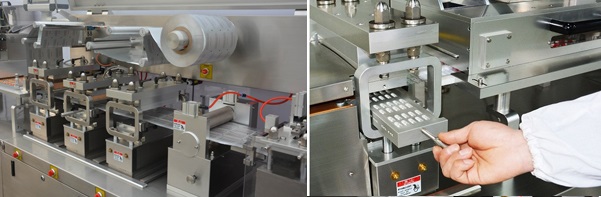
Maximizing OEE (Overall Equipment Effectiveness) requires minimizing auxiliary downtime. Modern blister machines utilize tool-less, “plug-and-play” mold changeovers. As demonstrated by the JORNEN DPP260Ki-2 (Figure 5), the integration of pneumatic positioning and automated mold locking allows operators to execute format changeovers rapidly and ergonomically.
Figure 5: Pneumatic tool-less mold locking system on the DPP260Ki-2.
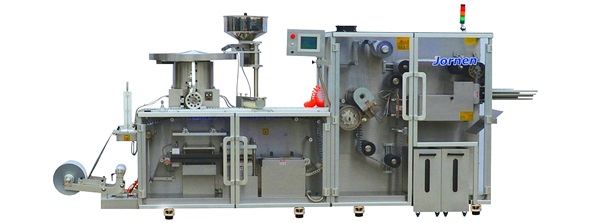
On the output front, industrial PCs paired with advanced servo architectures enable unprecedented speeds. The JORNEN DPH260 high-speed continuous-motion blister machine (Figure 6) achieves yields of up to 600 blisters per minute. When seamlessly connected to a continuous-motion cartoner, the unified line operates at an impressive 300 cartons per minute.
Figure 6: JORNEN DPH260 high-speed blister and cartoning line.
3. Diversification and Modular Flexibility
To accommodate modern agile manufacturing (multi-variety, short-run batches), blister machines must offer exceptional format flexibility. This involves modular structural designs where individual stations can be quickly swapped out to handle different materials (Thermoforming PVC/Alu vs. Cold-forming Alu/Alu) or varied lane configurations. Furthermore, advanced universal feeding systems are deployed to accurately load a diverse range of product geometries—including round, dual-convex, oval, and multi-sided tablets—even allowing for the co-packaging of different drug forms within a single blister card.
4. Intelligent Smart Manufacturing (Industry 4.0)
The ultimate frontier for packaging machinery is intelligent digitalization. Future-ready blister lines are equipped with comprehensive IoT capabilities, enabling remote diagnostics, predictive maintenance, and real-time production data evaluation. By integrating directly with enterprise ERP/MES platforms, these machines facilitate automated fault recovery and strict regulatory compliance. Alongside these technological leaps, modern equipment places an uncompromised emphasis on operational safety, ergonomic design, and energy conservation, minimizing both operational costs and environmental impact.