
Case Study: Highly Integrated Pharma Packaging Line (Pillow-Packing, Cartoning & Stretch-Banding)
03/14/2021
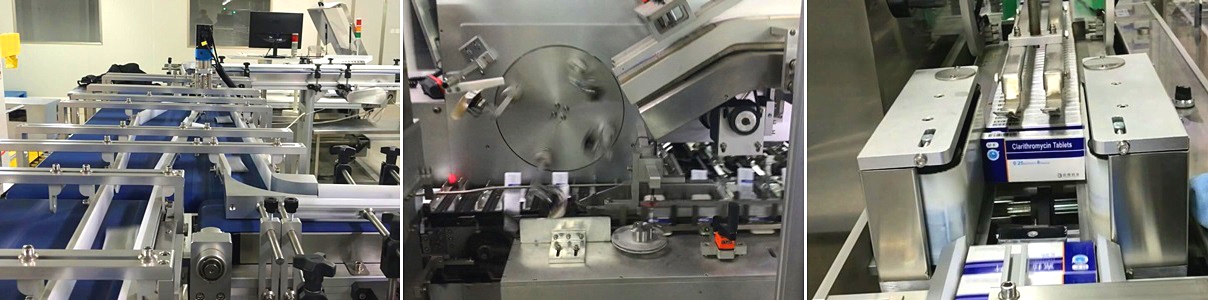
Cartoning Machine
Recently, Jornen successfully delivered a comprehensive, fully automated end-of-line packaging solution to a pharmaceutical client. This advanced line seamlessly integrates pillow-packing (flow wrapping), high-speed cartoning, online weighing, ink-jet printing, and stretch-banding into a single, highly efficient workflow.
1. High-Efficiency Blister Counting & The Pillow-Packing Advantage
The process begins with blister cards loaded into a magazine. A servo-regulated system accurately counts the blister cards as they free-fall onto the transfer chain, which then drives them into the pillow-packing unit.
💡 Why choose Pillow-Packing over traditional Alu-Alu Blisters?
Applying a pillow-pack (flow wrap) over standard blister cards significantly enhances the barrier properties against moisture, oxygen, and light, thereby greatly extending the drug’s shelf life. Furthermore, a single pillow pack can enclose multiple blister cards simultaneously. Compared to traditional Alu-Alu (cold-form) blister packaging, this method provides the same excellent level of barrier protection but consumes far less packaging material, making it a highly cost-effective and economical alternative for pharmaceutical manufacturers.
2. Dual-Lane Transfer & Automated Cartoning
After exiting the pillow-packing unit, the wrapped blister packs are discharged onto a transfer belt. As they move forward, a mechanical rake precisely guides them into two separate lanes to optimize the feeding speed. They then enter the cartoning machine.
Inside the cartoner, a servo-regulated feeder places the pillow-packed blisters into the transfer chain. The cartoning machine then automatically completes the entire sequence: leaflet folding, carton opening, product inserting, tuck-in (or hot-melt) closures, and discharging.
3. 100% Quality Control & Serialization (Ink-Jet Printing)
To guarantee zero defects, every discharged carton passes over a high-precision online checkweigher. Any faulty product with an incorrect weight is automatically rejected from the line.
The qualified cartons then proceed to the ink-jet printing station. This high-resolution printer applies variable data, such as date/lot codes and serialization barcodes for track-and-trace compliance. Ink-jet printing offers vastly superior legibility and clarity compared to traditional mechanical die embossing.
4. Final Secondary Packaging: Stretch-Banding
After printing, the cartons move to the final Stretch-Banding unit. Two soft belts smoothly turn the cartons 90 degrees and group them into larger matrix formats. These units are then tightly bundled with plastic stretch film, providing a secure, eco-friendly, and cost-saving final package ready for distribution.
Watch the Complete Line in Action:
(Jornen Machinery – Advanced Auto-Pack Technologies)