
How Does Online Pinhole Detection Work in Alu-Alu Blister Packaging?
12/04/2019
Medicines packed in blister machines have varying requirements for water and oxygen barriers. For pharmaceuticals highly sensitive to moisture and light, Alu-Alu (Cold Form Foil, or CFF) blister packaging is the gold standard. The Moisture Vapor Transmission Rate (MVTR) of an intact Alu-Alu blister pack is virtually zero, offering a nearly absolute barrier.
However, this complete protection is entirely dependent on the structural integrity of the formed aluminum web. How can pharmaceutical manufacturers guarantee that every single blister pocket is completely free of micro-cracks? The integration of an online pinhole detector is the definitive answer.
The Challenge: Micro-Fractures During Cold Forming
Unlike PVC thermoforming, Alu-Alu blister packs adopt an aluminum-based laminate film as the forming material. In the blister machine’s forming station, the aluminum film is mechanically pressed into a mold cavity using a Teflon stamp (plug assist). The aluminum is elongated under stress to maintain the formed pocket shape.
With modern aluminum foil rolling techniques, foils with a thickness of 20-25 microns in the laminate are generally considered free of inherent fractures. However, the mechanical elongation process makes them extremely vulnerable to cracking. Even if the film avoids catastrophic tearing, excessive stretching or sharp mold angles can create microscopic pores invisible to the naked eye.
These “pinholes” typically have a diameter of less than 100 microns (for comparison, a human hair is about 60-70 microns thick). A single pinhole destroys the barrier property of the pack, allowing moisture and oxygen to degrade the Active Pharmaceutical Ingredients (API) inside.
How the Online Pinhole Detector Operates
To ensure drug safety and perfect sealing performance, an advanced Alu-Alu blister packaging machine must be equipped with a high-precision online pinhole detection system.
- Infrared Optical Inspection: Installed immediately after the forming station, the pinhole detector features a specialized light emitter (typically far-infrared) that covers the entire width of the cold-formed aluminum web, paired with a highly sensitive light receiver positioned directly beneath the film.
- Zero-Defect Verification: As the cold-formed web passes through the detector, a perfectly intact aluminum film will block 100% of the light. The system’s interface will display a green light, confirming that no pinholes are present and the barrier property is fully assured.
- High-Sensitivity Detection: If the blister film has suffered micro-cracks or hairlike pinholes (e.g., 50-100 microns thick) due to unreasonable mold design or defective film batches, the infrared light will pass through these tiny pores and strike the receiver. The detector is incredibly precise, capable of identifying pinholes as small as 10 microns in diameter, with 6 configurable sensitivity levels: 10, 25, 35, 50, 70, and 100 microns.
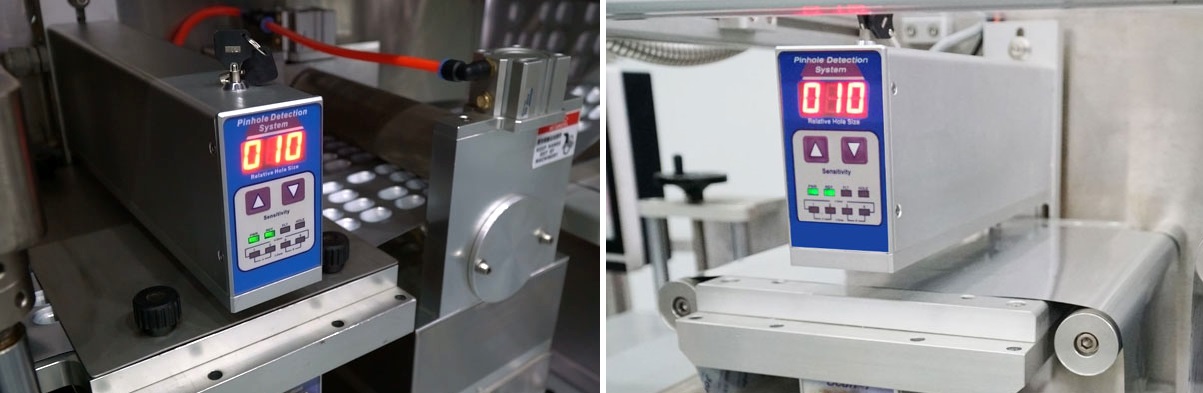
Alu-Alu Blister Machine equipped with an online pinhole detector
Automated Rejection of Faulty Blister Cards
When the size of a detected pinhole exceeds the preset sensitivity threshold, the system immediately triggers a red light warning signal. Simultaneously, it communicates directly with the blister machine’s central PLC.
The control system tracks the exact position of the compromised web index. It can automatically pause the product feeding mechanism for that specific faulty section to save medication. Once the compromised section reaches the punching station, the machine automatically rejects the faulty blister card and logs the error in the production records.
As a professional manufacturer of blister packaging machines, Jornen Machinery understands that offering flawless blister packaging equipment is not just an engineering goal—it is a critical responsibility for global drug safety.
(Jornen Machinery)