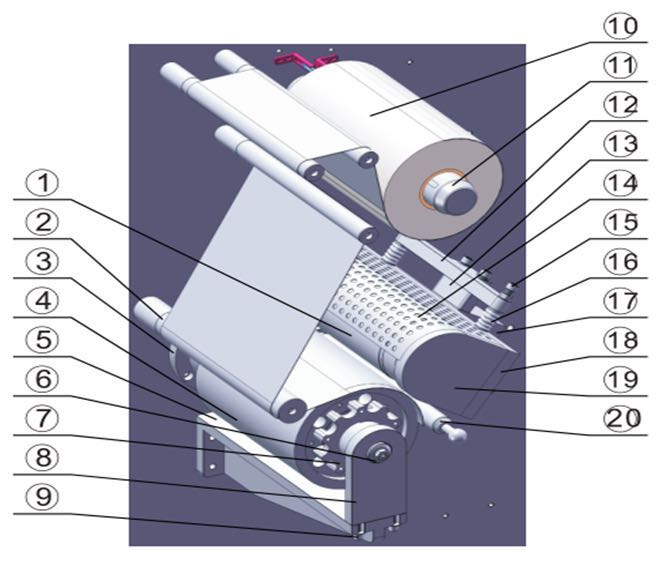
Schematic Diagram: DPH Series Blister Machine Rotary Sealing Station Architecture and Process Parameters
04/19/2019
The DPH series employs a continuous-motion rotary sealing architecture to bond the lidding foil to the formed web. Unlike intermittent platen sealing, rotary sealing utilizes a heated roller pressing against a synchronized rotary mold. This linear contact mechanism minimizes dwell time, prevents thermal transfer into the blister cavities, eliminates foil wrinkling, and achieves high sealing pressure with reduced mechanical force. This continuous indexing enables exceptionally high production speeds for standard solid dosage forms. For a complete technical overview of our continuous and intermittent format capabilities, please explore our Blister Packaging Machines.
1. Critical Process Parameters (CPP)
Sealing integrity is strictly governed by three interlocking parameters:
- Temperature: Nominal operation at ~220℃. Insufficient heat fails to activate the foil adhesive, while excessive heat structurally deforms the PVC cavities.
- Pneumatic Pressure: The cylinder actuating the heating roller must be regulated to approximately 0.4 MPa, ensuring a crisp knurled seal without inducing excessive mechanical stress on the machine bearings.
- Dwell Time: Dictated by machine indexing speed. It must be sufficient to melt the adhesive but brief enough to prevent trapped hot air from expanding and compromising the dosage form.
2. Standard Operating Procedure (SOP): Tooling & Material Changeover
- Lidding Foil Replacement: The foil loading shaft [11] features a quick-release locking mechanism. Rotate the switch to the horizontal position to depressurize and release the depleted core. Load the new foil roll and rotate the switch vertically to lock the core mechanically.
- Rotary Mold Changeover: Power off the machine while maintaining the compressed air supply (this ensures the pneumatic cylinder automatically lifts the heating roller [1] away from the mold). Shut off the cooling supply and detach the water connection [6]. Loosen the locking screw [9] to remove support seat 2 [8] and the connecting cover [7]. Extract the rotary sealing mold [4] from the drive shaft, mount the new format tooling, and reassemble the retaining components.
- Grid Uniformity Calibration: If the knurled sealing pattern is asymmetrical (e.g., deeper impressions on one edge), calibrate the mechanical tension using the dual spring adjusting screws [15]. Increase or decrease localized spring pressure until a uniform, hermetic linear seal is verified across the entire web width.
Critical Engineering Constraint (Machine Shutdown): Upon powering off the blister machine, the industrial water chiller MUST remain active for a minimum of 30 minutes. This sustained cooling cycle is mandatory to dissipate residual thermal mass and prevent catastrophic heat damage to the heating roller bearings.