Technical Guide: Cold Forming (Alu/Alu) Principle & Mechanical Structure (DPP Series)
04/12/2017
For highly light- and moisture-sensitive pharmaceuticals, traditional PVC thermoforming often provides insufficient barrier protection against oxygen and moisture ingress. To ensure optimal product stability and extend expiration dates, the DPP series utilizes Cold Forming Blister Packaging, commonly referred to in the industry as Alu/Alu packaging.
1. Cold Forming Process & Characteristics
Unlike thermoforming, which uses heat and compressed air, cold forming relies on a purely mechanical stamping process. A specialized aluminum laminate film is physically elongated and drawn into a cavity by a forming plug, permanently maintaining its new volumetric shape.
-
- Primary Advantage: Aluminum provides a near-absolute barrier against water vapor, oxygen, and UV light, maximizing the shelf life of highly sensitive active pharmaceutical ingredients (APIs).
-
- Operational Disadvantages:
-
- Slower production speeds compared to standard PVC thermoforming.
-
- Opaque material prevents visual inspection of the product by the end-user.
-
- Larger blister card footprint (aluminum cannot be formed at strict 90-degree draft angles, requiring wider cavity spacing).
-
- Operational Disadvantages:
2. DPP Series Mechanical Structure & Operation
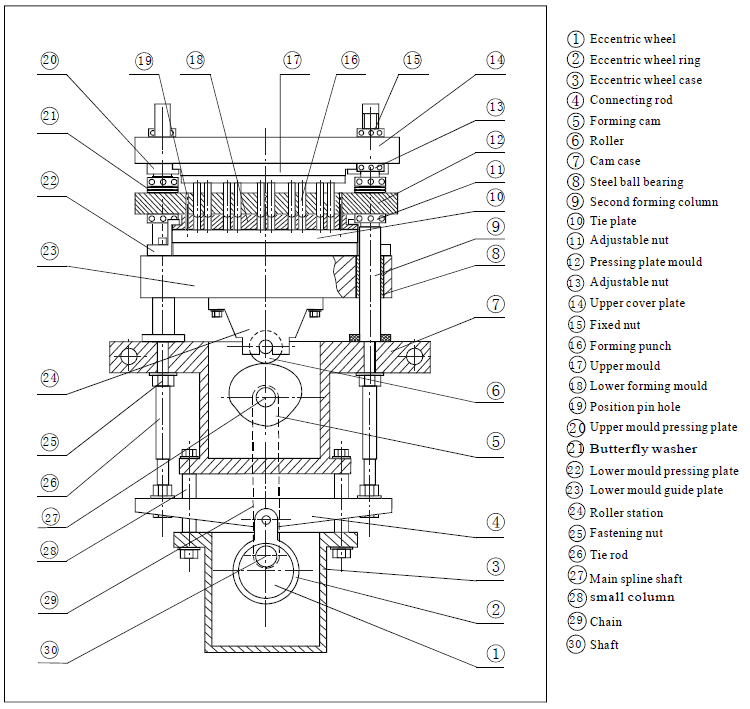
The synchronized mechanical sequence of the DPP Series cold forming station operates as follows:
-
- Web Clamping: As the flat aluminum film is indexed into the forming station, the forming cam (5) drives the lower mould (18) upward. This presses against the clamping plate (12) to securely fix the aluminum film in place and prevent wrinkling.
-
- Mechanical Drawing: Simultaneously, an eccentric wheel (1) drives the upper mould (17) downward. The specialized forming plugs (16) installed on the upper mould press into the clamped aluminum, physically stretching it into the lower mould to form the cavities.
-
- Final Sealing: After the solid dosages are filled into the opaque cavities, the web indexes to the sealing station, where it is hermetically sealed with a lidding aluminum foil to complete the Alu/Alu pack.
Cold Forming Structure Schematic