
European Case Study: Fully Integrated Blister and Cartoning Packaging Line
12/08/2019
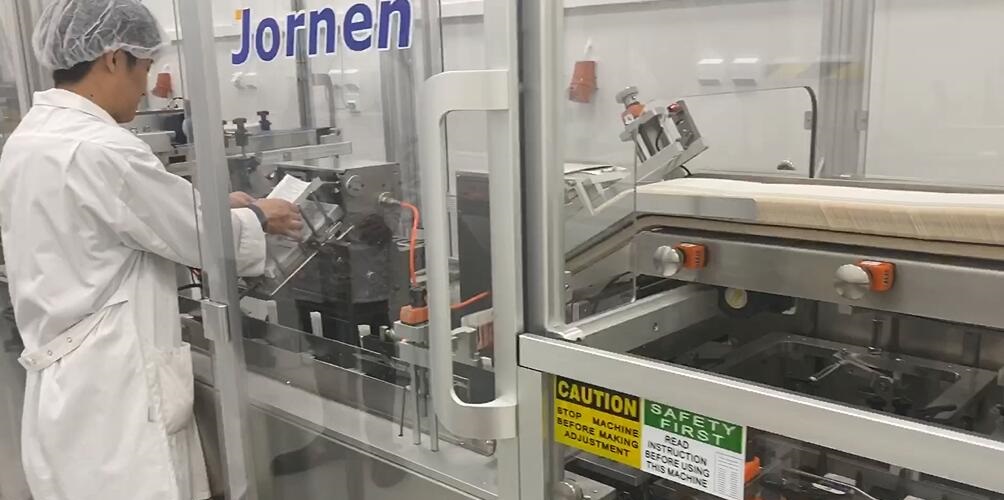
Blister Packaging Line in Europe
Recently, Jornen successfully delivered and installed a fully integrated blister packaging line for a pharmaceutical customer in Europe. Engineered to meet the most stringent European safety standards with a fully enclosed structure and safety doors, this high-performance line seamlessly combines three core units: the Blister Packaging Machine DPP260Ki-2, the Cartoning Machine ZH150, and a Stretch-Banding Machine.
Here is a detailed breakdown of how this integrated system maximizes efficiency, accuracy, and energy savings.
1. Advanced Camera Inspection System (Alu-PVC & Alu-Alu)
The blister packaging machine in this line is equipped with a state-of-the-art camera inspection system designed to handle both Alu-PVC and Alu-Alu formats within a single setup. It utilizes two distinct illuminants to guarantee 100% accurate defect detection:
- For Alu-PVC (Transparent Formats): The illuminant installed under the web emits light upward. If a pocket is correctly filled, the tablet blocks the light. If an empty pocket appears, the light shines directly through the transparent PVC, allowing the overhead camera to immediately identify the defect.
- For Alu-Alu (Opaque Formats): The bottom illuminant is deactivated. Instead, the illuminant above the web emits light downward onto the tablets and aluminum film. Because tablets and aluminum foil have entirely different reflective properties, the camera analyzes these reflections to spot missing or defective products.
(Note: With 30 years of experience, Jornen customizes inspection systems to meet specific pharmaceutical requirements, whether you only need to detect empty pockets or require complex inspections for crushed tablets, incorrect colors, or wrong sizes.)
2. The Heart of the Line: Seamless Vacuum Transfer
The core of any blister line is the connection unit between the blister machine and the cartoner. This European-spec line utilizes a highly reliable dual-vacuum-arm system:
- Rejecting Station: After the blister cards are punched upward, the first vacuum arm picks them up. If the camera system flagged an empty pocket earlier, this arm will reject the faulty card directly into a scrap container.
- Transfer to Cartoner: The second vacuum arm collects only the 100% qualified blister cards and places them onto a transfer belt. This belt feeds them directly into the cartoning machine, where the cards and a folded leaflet are smoothly inserted into the carton, embossed, closed, and discharged.
3. Eco-Friendly Stretch-Banding and Easy Changeovers
After cartoning, the packages are transferred to the Stretch-Banding Machine, where individual cartons are stacked and tightly wrapped in plastic film to form larger bundles.
Compared to traditional shrink-wrappers or overwrappers, this stretch-banding process is incredibly energy-saving because it does not require a heating tunnel. Furthermore, because it only partially covers the packaging bundle, it saves up to 50% on film materials.
Finally, because the entire line utilizes a synchronized transfer belt system rather than rigid mechanical pushers, operators can perform format and size changeovers much faster and with greater ease.
Watch the Blister Line in Motion:
See the complete integration of blister forming, robotic transfer, cartoning, and stretch-banding in the video below:
(Date: December 8, 2019)
(Jornen Machinery – Advanced Auto-Pack Technologies)