
Engineering Guide: Material Selection for Pharmaceutical Blister Packaging
10/31/2026
Introduction: Engineering Principles & Core Functions of Blister Packaging
Blister packaging is a globally adopted packaging format for solid dosage forms such as tablets and capsules. The engineering principle involves thermoforming a heated, softened plastic rigid film via positive air pressure or vacuum to create independent micro-cavities that house the product. This formed web is subsequently heat-sealed with a lidding foil.
The core function of this packaging system is to leverage the physical barrier properties of the materials to minimize the ingress of environmental moisture and oxygen, thereby reducing the risk of product deliquescence, oxidation, or degradation. This thin film serves as a critical first line of defense in extending a drug’s shelf life.
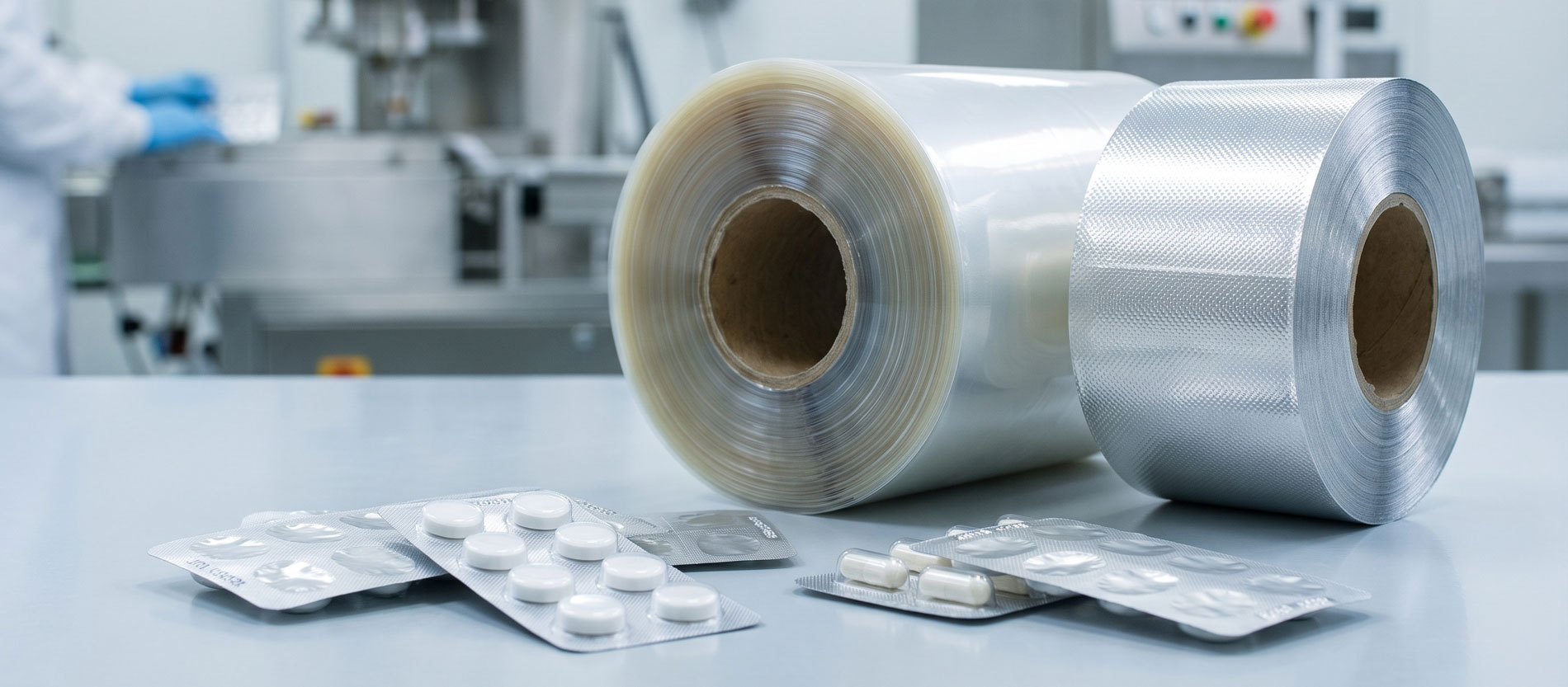
1. Blister Forming Films (Bottom Web) & High-Barrier Material Science
The stability of solid dosage forms is highly dependent on the water and oxygen barrier rates of the forming film. Based on different pharmaceutical characteristics and storage requirements, substrate materials are primarily categorized as follows:
-
- Standard Pharmaceutical PVC (Base Application): As the most widely utilized baseline material in the industry, a 250-micron standard PVC exhibits a Water Vapor Transmission Rate (WVTR) of approximately 2.5g/m²·24h. This specification is suitable for standard formulations with general environmental sensitivity. Note: If the material thickness exceeds 500 microns, its thermoforming capabilities decrease significantly, which may fail to meet the demands of high-speed, continuous blister machines.
-
- PVC/PVDC Coated Systems (Mid-to-High Barrier Upgrade): For highly hygroscopic drugs, the industry standard is to apply a Polyvinylidene Chloride (PVDC) coating onto the PVC surface. At the same thickness, a PVDC coating provides 5 to 10 times the barrier performance of basic PVC. While barrier rates correlate positively with coating weight, PVDC coatings exceeding 100g become brittle upon curing and typically require lamination with a flexible PE layer for physical protection. Furthermore, transparent PVDC is susceptible to yellowing and performance degradation under UV exposure or sustained high temperatures, necessitating strict light-protected storage.
-
- PVC/PE Multi-Layer Laminates (Specific Dosage Applications): These materials are frequently utilized for small-volume liquid preparations (e.g., oral liquids) and suppository packaging. The standard process involves laminating PVC rigid film with a PE film via adhesives and physical pressure. For extreme moisture and mold protection, this can be upgraded to a 3-ply PVC/PE/PVDC structure to further enhance comprehensive packaging protection.
- PCTFE / Aclar® (The Pinnacle of High-Barrier Films): Polychlorotrifluoroethylene (PCTFE) is currently one of the most exceptionally performing transparent barrier films, typically represented by Honeywell’s Aclar®. Featuring an ultra-low WVTR and robust chemical stability, it is dedicated to highly temperature- and moisture-sensitive, high-value innovator drugs and biologics. Due to raw material scarcity and manufacturing barriers, its procurement cost is notably higher than standard PVC and PVDC-coated products.
2. Lidding Foil Structure & Manufacturing
In terms of material consumption for blister packaging, the ratio of forming film to lidding foil is generally maintained around 4:1 (i.e., consuming 4 tons of PVC requires approximately 1 ton of aluminum foil).
Pharmaceutical lidding foil is rolled from high-purity (99%) electrolytic aluminum. Its cross-sectional profile from exterior to interior typically comprises: Protective Layer (OP), Ink/Printing Layer, Aluminum Foil Substrate, and Heat-Seal Adhesive Layer (VC/HSL).
The standard foil production workflow generally encompasses: Substrate Unwinding → Rotogravure Printing → Drying → Protective Layer (OP) Coating → Drying → Heat-Seal Adhesive (VC) Coating → Final Drying & Rewinding.
3. Engineering Selection & Matching Logic for Packaging Materials
When planning packaging production lines, pharmaceutical manufacturers are advised to select substrates based on the physicochemical properties of the drug, logically balancing packaging performance with material costs:
-
- Standard Moisture-Resistant Solid Dosages: Standard PVC rigid film typically fulfills basic compliance requirements.
-
- Formulations Requiring Oxidation & Mid-to-High Moisture Protection: PET or PP rigid films are recommended to support extended shelf-life requirements.
-
- Highly Hygroscopic Sensitive Drugs: High-barrier materials such as PVC/PVDC or PVC/PE/PVDC laminates are highly recommended.
- Suppositories & Liquid Dosages: PVC/PE laminated structures are standardly adapted to accommodate the unique forming and sealing requirements of liquid and semi-solid substances.