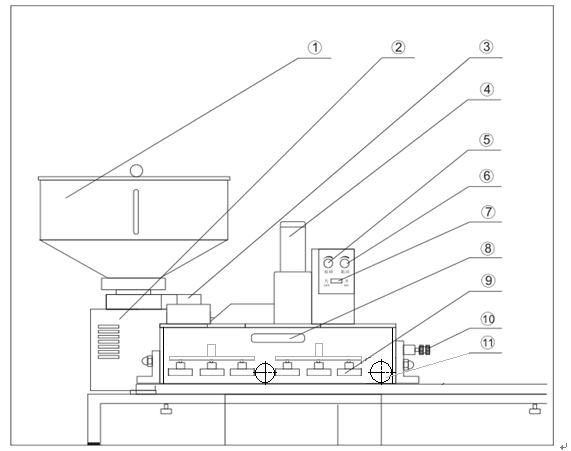
Schematic Diagram: DPH Series Blister Machine Format-Free Universal Feeding Device Architecture
02/15/2019
The universal feeding device for the DPH series Blister Packaging Machine is engineered for format-free versatility. It reliably processes a wide spectrum of solid dosage forms—including capsules, flat, oval, and triangular tablets—without requiring dedicated format parts. The core architecture integrates a feeding hopper [1], an electromagnetic vibrator [2], a linear vibratory conveyor [3], and a multi-axis brush distribution box [8].
1. Sensor-Regulated Feeding
The feeding box [8] incorporates an automated level-monitoring sensor. When the internal product volume drops below the optimal threshold, the closed-loop system signals the electromagnetic vibrator [2] to seamlessly index more product from the hopper via the linear vibratory conveyor [3], ensuring a continuous and consistent supply.
2. Kinematic Brush Distribution
Dosage positioning relies on a synchronized dual-axis brush system driven by the feeding motor [4]. Vertical rotary brushes [9] sweep the product into the formed blister cavities. Subsequently, horizontal brushes [11] mechanically orient the tablets to lay flat within the pockets. The final downstream horizontal brush features high-density bristles, acting as a physical gatekeeper to reject misaligned or stacked tablets before they exit the feeding zone.
3. Standard Operating Procedure & Maintenance
To initiate the feeding sequence, load the hopper [1] and activate the power switch [7]. Modulate the vibration control switch [6] to optimize product flow, and adjust the brush control switch [5] to synchronize the brush RPM with the machine’s forming speed. For maintenance, the feeding box features an ergonomic handle and a mechanical lock [10] to secure the unit in an elevated position, allowing for rapid brush replacement and line-clearance cleaning.
Critical Engineering Constraint: Before engaging the feeder, operators must visually verify that the unformed (blank) PVC web has completely cleared the feeding zone. Dispensing solid dosage into an unformed web will cause catastrophic product crushing and severe mechanical damage to the downstream rotary sealing station.