
Selection Guide for Laboratory Blister Machines: Compliance, Efficiency, and Technical Architecture
11/03/2026
Engineering Note: This technical documentation provides a comprehensive guide to selecting laboratory-scale blister packaging equipment. It is designed to assist pharmaceutical engineers and R&D managers in evaluating compliance, mechanical architecture, and efficiency for clinical trial and stability sample preparation.
In modern pharmaceutical R&D and pilot-scale operations, high-quality blister packaging is no longer exclusive to mass production facilities. To accelerate time-to-market and ensure the absolute stability of clinical trial supplies, R&D laboratories increasingly rely on high-precision, in-house packaging solutions. However, the unique environments and stringent cGMP compliance requirements of laboratories dictate that selecting a lab-scale blister machine differs fundamentally from choosing traditional production equipment. This guide provides an in-depth analysis of the core selection logic for pharmaceutical laboratory blister machines.
1. Do Laboratories Need a Blister Machine? Scenario Analysis
Not all laboratories require blister packaging capabilities; the necessity depends on the core workflow:
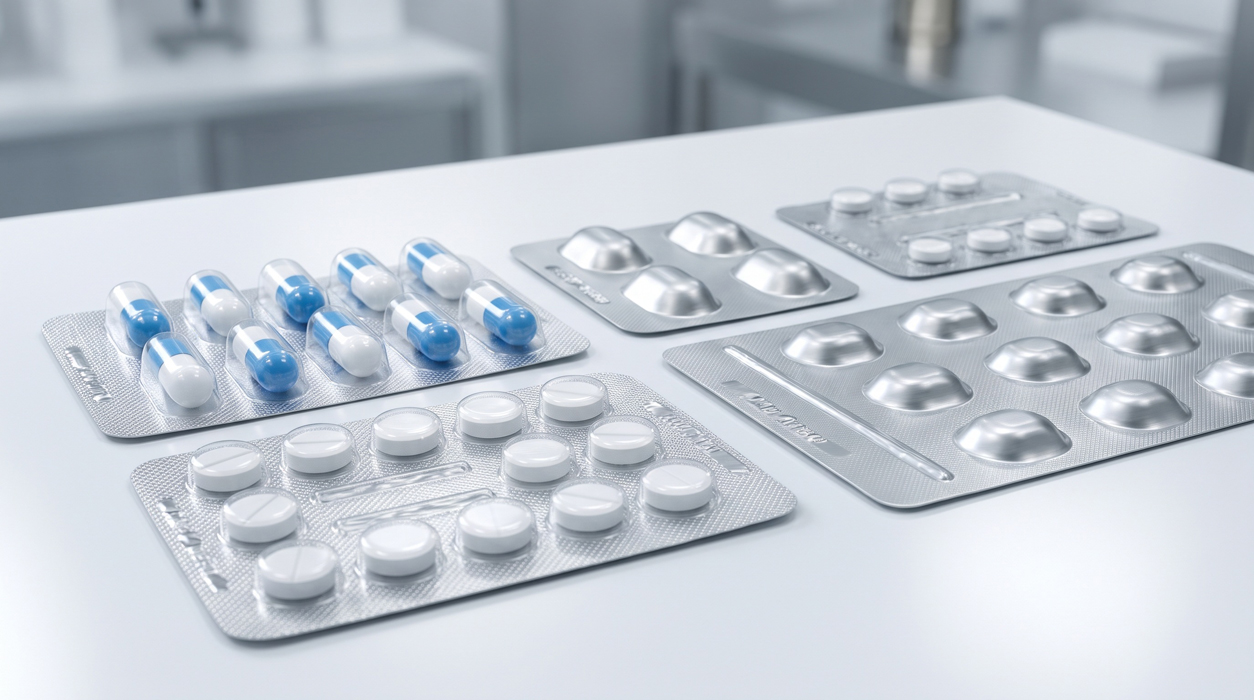
- Essential Scenarios: Formulation R&D, pilot laboratories, and academic/research institution pharmaceutical labs. These facilities handle formulation development for new dosage forms (tablets, capsules, etc.). During small-batch sample preparation, stability testing, and retention sample storage, a blister machine capable of rapid format changeovers and flexible, independent operation is indispensable.
- Non-Essential Scenarios: Pure QC (Quality Control) laboratories (focused on analytical testing) or basic medical/bioanalytical laboratories (which do not involve formulation packaging).
2. Core Architecture Showdown: Balcony vs. Traditional Box-Type
Once the need is established, the foundational mechanical architecture is the primary factor determining compliance. For pharmaceutical laboratories, the conclusion is clear: A balcony-style blister machine is the mandatory first choice.
- Why is the Balcony Structure Mandatory? The core of the balcony design is “physical isolation.” Its transmission system and core drive components are completely enclosed at the rear of the machine, while the packaging work area is cantilevered at the front. This design eliminates exposed transmission structures, ensuring that oil and metal debris never fall and contaminate the pharmaceutical products. The fully open front work area leaves no sanitary dead corners and allows laboratory personnel to perform rapid cleaning and format changeovers in minimal time, perfectly aligning with stringent cGMP requirements.
- The Fatal Flaw of Traditional Box-Type Structures: Traditional box-type equipment houses the transmission structure underneath. During operation, not only do metal shavings and lubricating oil mist from bottom wear easily drift upward into the work area, but simultaneously, tablet debris or powder from the work area can easily fall through gaps in the tabletop into the mechanical transmission area below, creating internal unsanitary dead zones that are impossible to clean thoroughly. This interconnected top-and-bottom design introduces severe risks of two-way cross-contamination, making it extremely difficult to pass cGMP compliance inspections. Such machines are only suitable for non-pharmaceutical packaging teaching demonstrations with no cleanliness requirements.
💡 Engineering Solution Recommendation:
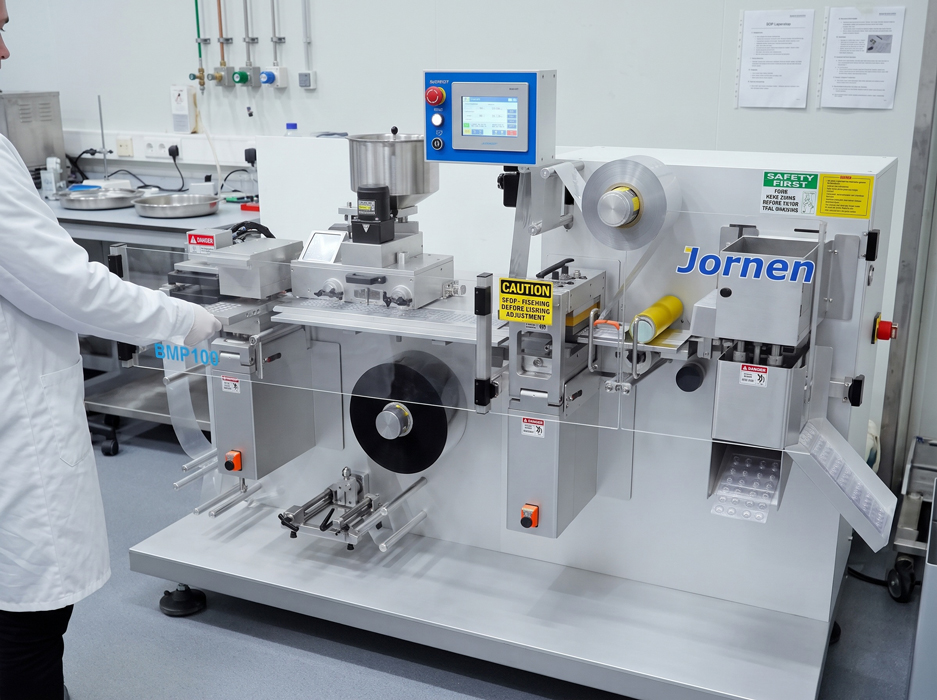
If your laboratory requires a compact machine that perfectly meets the aforementioned cGMP standards, we highly recommend evaluating the JORNEN BMP100 Laboratory Blister Machine, designed specifically for pharmaceutical R&D. Adopting a pure balcony architecture, it completely eliminates outsourcing delays and maximizes R&D efficiency for multiple product varieties through its tool-less format changeover design.
If your laboratory requires a compact machine that perfectly meets the aforementioned cGMP standards, we highly recommend evaluating the JORNEN BMP100 Laboratory Blister Machine, designed specifically for pharmaceutical R&D. Adopting a pure balcony architecture, it completely eliminates outsourcing delays and maximizes R&D efficiency for multiple product varieties through its tool-less format changeover design.
3. Four Engineering Dimensions to Verify GMP Compliance
When selecting equipment, rigor is essential. Verify GMP compliance through the following four dimensions:
- Material and Surface Finish: Components in direct contact with pharmaceuticals must use medical-grade 304/316L stainless steel with a mirror-polished surface (roughness Ra≤3.2μm) and zero sanitary dead corners.
- Data Integrity Requirements Grading: If the equipment is used to prepare clinical trial supplies or regulatory-grade stability batches, the control system (PLC/HMI) must feature a native, time-stamped audit trail and role-based access control, complying with 21 CFR Part 11 standards. For early-stage formulation exploration, a basic control system can be selected on-demand to reduce procurement costs.
- DQ/IQ/OQ/PQ Validation System: The supplier must provide a complete set of validation documents, from User Requirement Specifications (URS) to Installation/Operational/Performance Qualification (IQ/OQ/PQ), as a statutory prerequisite for compliance acceptance.
- Error Prevention and Parameter Control: Critical process parameters (sealing temperature, forming pressure) must be precisely adjustable. The machine should feature automatic alarm functions for position deviations to guarantee consistent packaging quality across different batches.
4. Automation Configuration and Operational Human Resources
- Automatic Feeding System: Selection Logic Based on Space Constraints
Given the highly compact feeding area on the worktable of a micro laboratory blister machine, the decision to equip an automatic feeder must be evaluated based on the dosage form:
– Recommended (Standard Dosage Forms): For standard hard capsules or round tablets, equipping an automatic feeder is advised. The corresponding feeder structures are relatively compact, which significantly improves feeding efficiency and avoids cross-contamination risks from manual handling.
– Not Recommended (Odd-shaped Tablets): For odd-shaped tablets, the required automatic feeders are often structurally complex and excessively bulky, rendering them highly incompatible with the compact footprint of a lab machine. In such cases, purely manual feeding is far more flexible and operationally feasible. - Is a Dedicated Mechanical Engineer Required?
Absolutely not. Modern laboratory blister machines (like the BMP100) emphasize user-friendly operation. Their stable servo-driven indexing and modular design allow regular laboratory personnel to operate the machine proficiently and perform routine maintenance after basic training. Most laboratories can achieve highly efficient operation simply by relying on the manufacturer’s after-sales support and a general internal equipment administrator.
Conclusion
Selecting a pharmaceutical laboratory blister machine is an engineering decision that seeks the perfect balance between a “minimal footprint” and “maximum GMP compliance.” Identifying core features such as a “compact design, balcony structure, and tool-less rapid changeovers,” while reasonably matching the feeding system to the actual dosage form, will ensure your R&D packaging process is efficient, sterile, and capable of withstanding the most stringent regulatory scrutiny.