
Technical Comparison: Strip Packaging vs. Blister Packaging Architecture
07/07/2019
Engineering Note: This technical comparison differentiates the structural and kinematic architectures of strip packaging versus blister packaging. It has been expanded to assist pharmaceutical packaging engineers in evaluating barrier requirements, material consumption trade-offs, and critical feeding limitations for highly sensitive solid dosage forms.
1. The Core Architectural Distinction: Cavity Formation
The fundamental mechanical difference between a strip pack and a blister pack lies in how the containment zone is created. A blister pack relies on a base web that undergoes mechanical thermoforming (for plastics like PVC/PVDC) or cold-forming (for Alu-Alu) to generate distinct, pre-formed cavities prior to the product feeding stage.
Conversely, a strip pack utilizes two continuous sheets of flexible laminate and completely lacks pre-formed cavities. In this process, the tablet or capsule is synchronized to drop directly into the sealing nip between two heated molds (typically rotary sealing rollers). The laminate webs are dynamically heat-sealed around the dosage form, encapsulating the product in real-time.
Conversely, a strip pack utilizes two continuous sheets of flexible laminate and completely lacks pre-formed cavities. In this process, the tablet or capsule is synchronized to drop directly into the sealing nip between two heated molds (typically rotary sealing rollers). The laminate webs are dynamically heat-sealed around the dosage form, encapsulating the product in real-time.
2. Strategic Advantages: Supreme Barrier Integrity
Strip packs are predominantly constructed using Al/PE (Aluminum/Polyethylene) laminated films. The combination of an absolute aluminum barrier and the excellent heat-sealing properties of polyethylene provides a protective environment that rivals premium cold-form (Alu-Alu) blister packs. This near-zero transmission barrier perfectly shields highly sensitive active pharmaceutical ingredients (APIs) from moisture (MVTR), oxygen (OTR), and UV light degradation. Consequently, strip packaging remains the gold standard for effervescent tablets, highly hygroscopic drugs, and products distributed in extreme climate regions (ICH Zones III and IVb).
3. Production Trade-Offs and System Limitations
While offering exceptional protection, strip packaging introduces specific engineering and economic compromises compared to traditional blister lines:
- Slower Production Kinematics: Because the encapsulation relies on the precise, synchronized free-fall of the product matching the sealing mold rotation, the overall operational speed is inherently slower than the continuous, high-speed output of a modern thermoforming blister line.
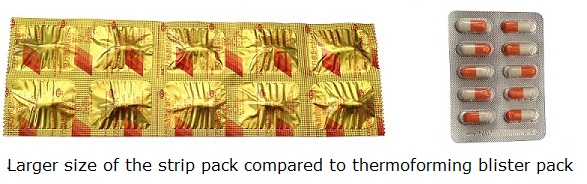
- Increased Material Footprint: Without a deep-drawn cavity to snugly house the tablet, a strip pack requires a significantly larger surface area of laminated film to successfully bond around the perimeter of each item. This larger footprint drastically increases material consumption and raises the cost per unit dose.
- Formidable Feeding System Constraints: Unlike blister machines that utilize a vast array of versatile feeding architectures, strip packaging predominantly relies on rigid, gravity-driven vertical drop chutes. While adequate for standard capsules and round tablets, this gravity-feed method often fails with odd-shaped or deeply concave tablets, which bridge and jam inside the tubes. Furthermore, uncoated, friable tablets cause progressive dust accumulation within the chutes, eventually blocking material flow entirely. These severe feeding limitations make the application scope of strip packaging significantly narrower than that of highly adaptable blister lines.
- Dispensing Ergonomics: Standard blister packs offer a convenient “push-through” mechanism. Strip packs, constructed from tough Al/PE laminates, generally require the patient to tear the package open along perforations, which can impact dispensing convenience for certain demographics despite offering inherent child-resistant (CR) properties.