
Optimizing Heat Sealing Quality in Pharmaceutical Blister Packaging
11/07/2026
The usage of blister packaging for solid dosage forms is a fundamental practice in the global pharmaceutical industry. Driven by strict cGMP standards and international regulatory requirements, pharmaceutical manufacturers demand flawless sealing quality to ensure product safety, stability, and extended shelf life.
An ideal heat-sealed blister pack must feature clear, dense, smooth, and evenly distributed knurling (reticulate) patterns, completely free from micro-punctures and wrinkles. Because heat sealing is a highly dynamic process, controlling its quality requires precise engineering. This article explores the core principles of heat sealability in rotary blister packaging machines and analyzes the critical factors necessary to achieve perfect seal integrity.
1. The Golden Triangle of Sealing: Temperature, Time, and Pressure
In rotary blister packaging machines, the aluminum foil (lidding) and the formed PVC (or other base webs) are heat-sealed together under the combined action of a heating roller and a knurled sealing roller. The ultimate sealing effect is determined by three interacting variables: temperature, time, and pressure.
Ideally, a combination of “lower temperature, longer dwell time, and high pressure” produces the best results: minimal PVC deformation, crisp blister cavities, and deep, clear knurling patterns without foil puncturing. However, as modern blister machines achieve higher production speeds, the web indexing speed increases, proportionally shortening the heat-seal dwell time. To compensate for this reduced time and maintain a high yield rate, the sealing temperature must be carefully elevated.
The total heat energy transferred to the packaging materials per unit of time is a function of both temperature and pressurization time. Modern high-speed machines utilize advanced pre-heating zones to compensate for shorter sealing times, ensuring perfect adhesion without compromising the integrity of the 0.25mm PVC base web.
2. Point Sealing vs. Grid Knurling (Dot vs. Line Sealing)
After the blister machine completes forming and automatic feeding, the base web enters the heat-sealing station alongside the adhesive-coated aluminum foil. Sealing patterns are generally categorized into two types: Point Sealing (Dot) and Grid Knurling (Line).
Point sealing is often utilized in older platen-sealing machines. While the dense, dot-like points are visually appealing, the individual dots are disconnected. This lack of continuity creates potential micro-channels, making the package highly susceptible to capillary leakage if process parameters fluctuate.
In contrast, Grid Knurling (Line Sealing)—the standard for modern rotary blister machines—features intersecting lines that form a continuous, crisscrossed matrix. Because the sealing pressure points are connected, the seal is vastly more secure. Vacuum leak-detection tests using colored dye consistently prove that grid knurling withstands pressure differentials much better than disconnected point sealing, guaranteeing superior barrier protection.
3. Designing the Optimal Reticulate Knurling Pattern
Even with optimal temperature, time, and pressure, sealing success heavily depends on the physical geometry of the knurling roller. Standard industry grid knurling features crisscrossed oblique lines with a fixed spacing of roughly 0.8 mm, and requires a minimum distance of 2.5 mm between adjacent blister cavities to ensure at least one full knurling grid is formed in the sealing area (see Fig. 1).
A critical engineering challenge is preventing the 0.02mm aluminum foil from tearing. If the peaks of the knurling grid are machined too sharply, they will pierce the foil during compression. Conversely, arbitrarily reducing the pressure to avoid puncturing leads to weak, shallow seals.
The JORNEN Solution: To fundamentally resolve this, the depth and peak geometry of the knurling pattern must be engineered with a truncated profile. By machining a micro-platform (flat top) of just 0.05 mm at the peak of each knurl (see Fig. 2) and maintaining a surface roughness (Ra) of 3.2, foil stretching is drastically reduced. This flat-top profile eliminates foil punctures even under high pressure, allowing operators to safely adjust temperature and speed parameters without risking material failure.
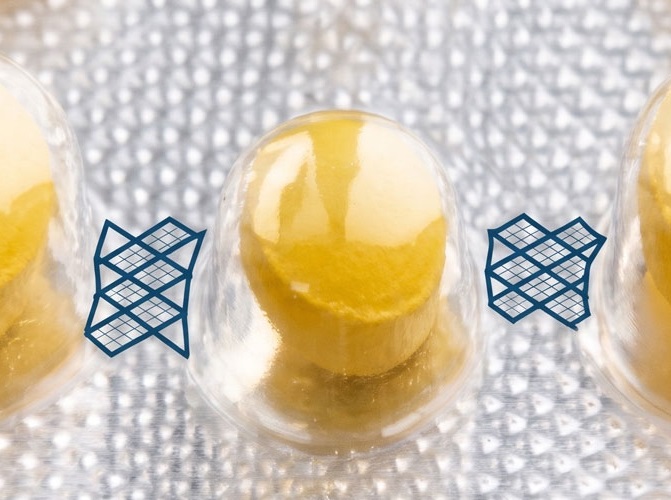
Fig. 1 Grid knurling pattern between blister cavities to ensure secure and airtight heat sealing. 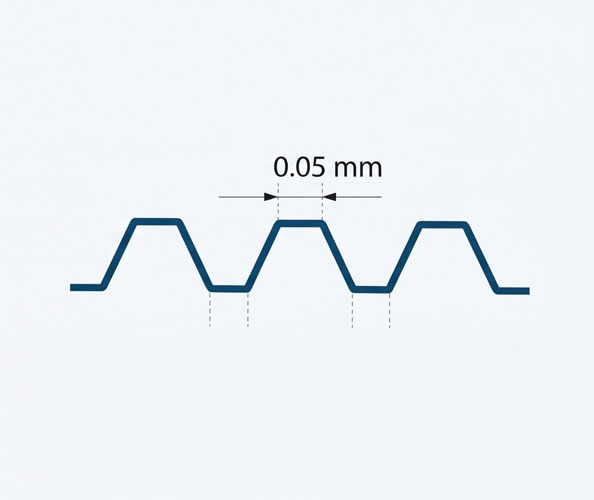
Fig. 2 The engineered flat-top (truncated) knurling profile featuring a 0.05 mm micro-platform to prevent foil tearing during high-pressure sealing.
4. Thermal Uniformity via Cast-in Heaters
Consistent sealing across the entire web width requires absolute thermal uniformity on the heating roller. Traditional machines often utilize direct plug-in electrical heating cartridges inserted into the roller. This design inevitably leaves micro air gaps (dead zones) between the cartridge and the roller wall, causing localized air oxidation, thermal inefficiency, and cold spots that lead to periodic weak seals on one side of the web.
To guarantee premium sealing quality, modern equipment replaces standard plug-in cartridges with one-piece cast-in heaters. In this design, the heating elements are permanently cast inside a highly conductive metallic block, eliminating air gaps entirely. This ensures seamless heat transfer to the sealing roller surface, completely eradicating temperature nonuniformity, preventing internal oxidation, and significantly extending the lifespan of the heating components.
5. Precision Alignment and Roller Parallelism
Finally, the knurled sealing roller and the heating roller must be perfectly parallel. Any deviation in parallelism results in uneven pressurization across the contact line, leading to strong seals on one edge and weak seals on the other. Advanced rotary blister machines incorporate self-aligning mechanical tolerances that allow the knurled roller to dynamically micro-adjust its position during operation, maintaining absolute parallelism with the heating roller and ensuring 100% sealing uniformity.
Conclusion
Achieving defect-free heat sealing in pharmaceutical packaging is a complex synergy of thermodynamics, material science, and precision mechanical engineering. By mastering the balance of sealing parameters, engineering flat-top knurling profiles, utilizing cast-in thermal technology, and ensuring perfect roller parallelism, manufacturers can achieve reliable, high-speed blister packaging that meets the world’s most stringent pharmaceutical standards.