Blister Packaging Solutions for Irregular-Shaped Tablets
Standard round tablets are simple and economical, but many pharmaceutical companies opt for complex, non-round irregular shapes to enhance product value, market positioning, and brand identity. These shapes—including olive, oblong (capsule-like), rhombus, square, and triangular—significantly increase blister packaging difficulty:
Mold Machining Costs: CNC programming for complex forming and sealing molds is more intricate. Highly complex shapes may require electronic engraving, increasing both programming time and overall manufacturing costs.
Feeding Smoothness: Irregular tablets often suffer from poor flowability or interlocking inside feed tubes. This leads to low feeding rates, high rejection rates, increased manual intervention, frequent machine downtime, and reduced overall equipment efficiency.
Blister Feeders Selection Guide for Irregular Tablets
It is difficult to prescribe a universal feeder for all irregular tablets, but the following guidelines apply:
This feeder uses brush agitation to sweep tablets into pockets, recommended for high-hardness or coated tablets. It is “universal” because it accommodates most irregular shapes, albeit at reduced feeding rates and machine speeds.
Technical Features: Small olive and oblong shapes roll easily under brushes, yielding better feeding rates. Conversely, square, triangular, and rhombus shapes flow poorly; a triangular tablet, for example, must perfectly align its three corners with the pocket to drop in, drastically reducing feeding probability. Because feeding takes longer, tablets endure prolonged brushing, requiring higher surface hardness (preferably coated) to prevent abrasion. Format parts are not required, making it cost-effective for multi-product, small-batch runs on low-to-medium speed machines.
Capacity Reference: For olive and oblong shapes on standard flat-plate machines, speeds range from 25–30 cycles/min (approx. 100–120 plates/min on a 260mm PVC machine punching 4 plates). Speeds for rhombus and triangular shapes drop below 20 cycles/min. Actual capacity depends heavily on tablet dimensions, thickness, and hardness, requiring physical testing.
Tablet Size Influence: Ideal dimensions for fluidity are lengths of 10–12mm, widths of 4–6mm, and thicknesses of 4–6mm (for olive shapes: W 6mm, T 4mm). Excessive deviations disrupt smooth feeding.
Limitations: Unsuitable for Alu/Alu cold-form packaging unless the tablet is thin (thickness within 4mm) and drawing depths are shallow.
2. Multi-Product Co-Line Option: Vibratory & Rolling Drum Feeders
Ideal for uncoated or low-hardness tablets to prevent brush-induced damage. A vibratory bowl guides tablets into vertical channels, where moving webbing conveys them into the pockets.
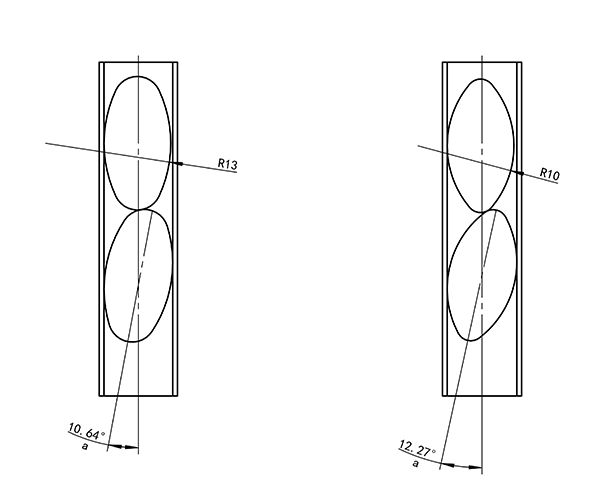
Width Radius (R1): A larger R1 reduces the swing angle, preventing vertical jamming in the channel. As illustrated in Figure 1, the tablet on the left with a larger radius is less likely to jam, whereas the one on the right with a smaller radius is prone to jamming.
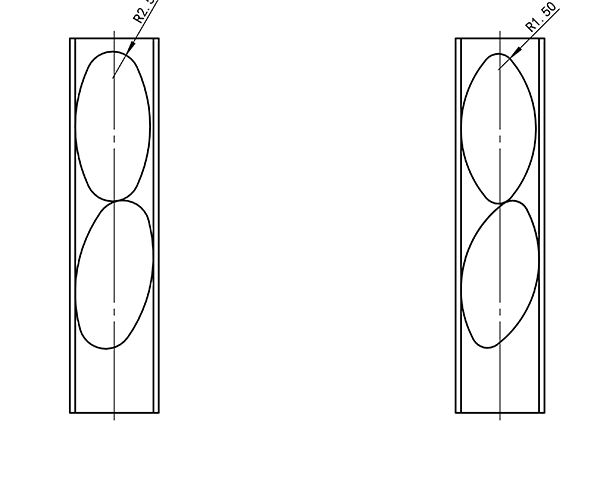
Length Radius (R2): A larger R2 prevents head-to-tail interlocking; pointed ends increase jamming risks. As illustrated in Figure 2, the tablet on the left with a larger radius prevents interlocking, whereas the one on the right with a smaller radius is prone to jamming.
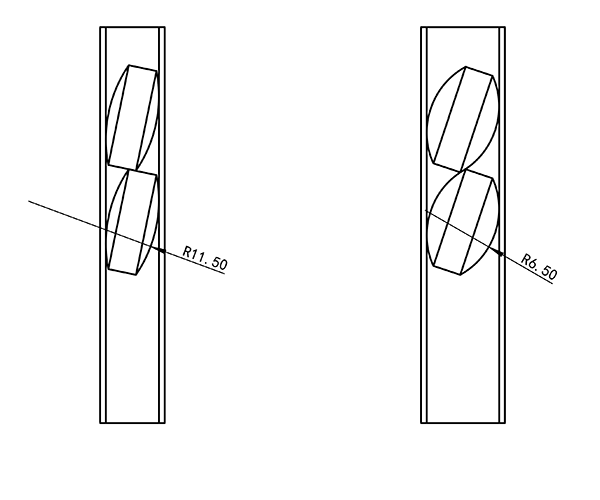
Concavity: Deep biconvex profiles are prone to jamming compared to flat or shallow concave shapes. As illustrated in Figure 3, the shallow concave tablet on the left flows smoothly, whereas the deep biconvex tablet on the right is highly prone to jamming.
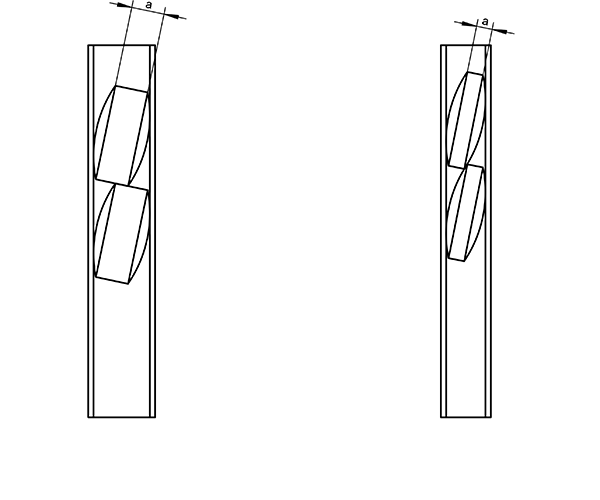
Edge Thickness: Extremely thin edges (deep biconvex tablets) cause twining and capping, leading to severe clogging. As illustrated in Figure 4, the tablet on the left with a thicker edge avoids overlapping, whereas the thin-edged tablet on the right is highly susceptible to twining and severe jamming.
Thickness Tolerance: Must be controlled within ±1%. Square tablets must meet this tolerance, be flat/shallow concave, and possess adequate edge thickness (see Figure 4).
Note: Professional software simulation and physical sample testing are required for accurate evaluation.
Figure 1
Figure 2
Figure 3
Figure 4
Cold-Form Application: A rolling drum is added below the channels (Rolling Drum Blister Feeder) to precisely feed Alu/Alu cold-formed pockets.
Capacity Reference: Around 100 cycles/min for oblong/tablet shapes (approx. 400 plates/min on a 260mm PVC machine punching 4 plates).
Technical Features: Configured with multiple internal feed tubes corresponding to blister pockets for an instant, large-area drop. It functions like multiple stacked Vibratory Feeders; if a tablet does not jam in a vibratory channel, it will perform well here. Compatible with flat/intermittent and rotary/continuous machines for both thermoforming and cold-forming.
Capacity Reference: Up to 600 plates/min (260mm machine, 80x45mm grid, 3 plates per cycle) assuming smooth downward flow.
Limitations: Strict requirements on tablet radii, thickness variations, edge thickness, and surface smoothness to prevent catastrophic tube clogging. High equipment investment and relatively complex routine cleaning.
Due to the infinite geometric variations of irregular tablets, feeding efficiency fluctuates significantly from one project to another. Therefore, it is scientifically impractical to provide a standardized capacity chart or strict machine selection guide without evaluating your specific tablet design and physical samples.
However, the fundamental mechanical speed and configuration matrix of our blister machines remain constant. To understand our comprehensive machine lineup and view the theoretical maximum capacity references (baseline data based on standard round tablets), please visit our dedicated guide:
Expert Advice for Irregular Shapes: We highly recommend sending us your 3D tablet drawings (CAD/STEP files) or physical samples. Our engineering team will conduct professional software simulations and factory feeding tests to provide you with an accurate, customized capacity report and the most suitable machine recommendation.